
Interview with Emily Gale, author of The Wild Unknown, published by Text Publishing, 2026

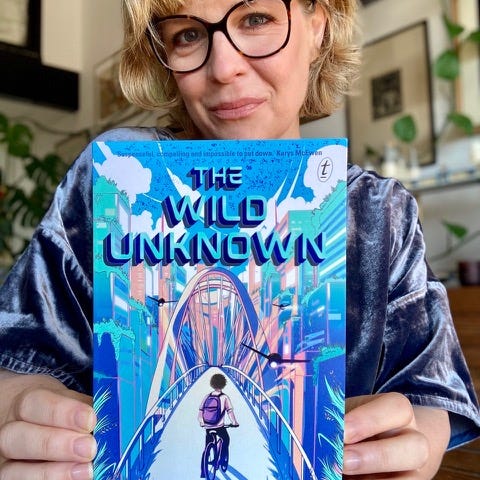
Emily Gale’s work includes the junior fiction duology Eliza Boom, middle-grade novels The Other Side of Summer, Elsewhere Girls and Outlaw Girls (co-written with Nova Weetman), The Goodbye Year, and most recently The Wild Unknown, as well as the YA novels Girl, Aloud, Steal My Sunshine, and I Am Out With Lanterns. Emily’s books have been published all over the world and shortlisted for a number of awards.
Website: www.emilygalebooks.com
Substack: https://emilygale.substack.com/
Congrats Emily on your new book The Wild Unknown, where did the inspiration for your latest book come from and how long did it take you to write?
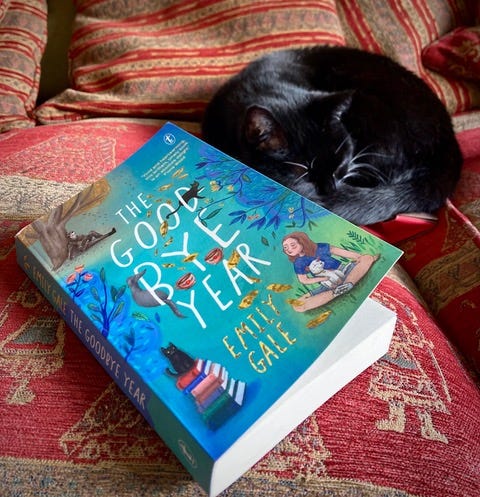
It was as my son was beginning his final year of primary school that I noticed a growing tension between what he’d loved as a little boy — he was an animal lover, a dinophile, a fan of mythical beasts — and how he was increasingly drawn to spending his time — gaming. Because I was playing my part as a parent by restricting the time he spent gaming, the tension between generations as things change was also on my mind, and of course he was also approaching puberty so I was thinking about physical transformations and the very nature of ‘progress’, what we lose or gain. So The Wild Unknown began as a transformation story, and as my son is about to start a course at the polytechnic that tells you how long it took me to write! In between I wrote The Goodbye Year, Elsewhere Girls and Outlaw Girls.
The futuristic setting of this book in 2045 is very different from your previous books such as Outlaw Girls and Elsewhere Girls, how do you find writing in different time periods and does this affect the type of research that you do?
I was intimidated by my own decision to set the book in 2045 because I’ve always felt much more comfortable looking backwards, and with poking about in and challenging historical narratives to tell new stories. But The Wild Unknown still involved a certain amount of looking back because in order to make judgements about how much the world around me is going to change in around twenty years, I studied historical change. Just as I’d maintained a research file split into relevant sections for both Elsewhere Girls and Outlaw Girls, I was constantly feeding my research file for The Wild Unknown with articles about medicine, food, climate, genetics and DNA, education, technology, and anything else I thought might be of relevance to a family of four living in Melbourne. Some of that research came from countries that are further ahead in their use of technology, and some came from expert forecasts. That all went into a big soup in my head along with a generous amount of imagination. And as any historical novelist will tell you, about a tenth of what I researched made it anywhere near the final story.
As a writer that writes in a number of different genres, do you have a favourite genre to read? Is there a different genre that you would like to try next?
I read widely across fiction. To give you a glimpse into what that looks like in my reading life, the last ten books I read were: a YA verse novel, an contemporary epistolary novel, a literary speculative novel, a contemporary school drama, a children’s techno-thriller, a cosy crime, a legal thriller, a vintage children’s gothic novel, a picture book, and a fictionalised sixteenth-century biography. Every time I read something that moves me, I think: could I do that? Most of the time, my answer is no, but every now and then curiosity gets the better of me and I give something new a go. I would dearly love to write a decent picture book one day.
Can you tell me about your own writing process and routine, are you a plotter, pantser or a plantser i.e. a bit of both? Are you a lark or a night owl?
I was a night owl as a young woman and now I’m a lark, but when I’m in the most devoted stage of writing a novel, towards the end, you’ll find me writing first thing in the morning and last thing at night. In terms of my process for a first draft, I enjoy setting off into the wild but I have a sight level on me and I’ll stop at intervals to see what’s up ahead. I also document what I’ve already done story-wise so that I can easily refer back to it without reading the whole draft, and so that I can start to feel the shape of the story and whether I’m coasting anywhere or going off on a tangent. None of this means that my first drafts don’t need a lot of work but this is how I make the process enjoyable for myself.
How does your background in publishing inform your writing career? And did you always want to be a writer?
I always wanted to write but in my early twenties I was renting with friends in London and just playing around with the start of a novel, so it was a dream that lived in the back of my mind while I got on with being an editor. I had a fast and varied time as an editor but there was so much about publishing that I still didn’t know, and my writer self and publishing self didn’t feel connected back then. In fact the first time I tried to get an agent, when I was twenty-six, I acted like a total beginner and sent off three chapters of a novel that I hadn’t finished writing, was promptly asked to send in the whole manuscript and lost my bottle — I never wrote another word of that story. The strongest influence that being an editor has had on me is my willingness and ability to take a story apart and put it back together. Working for a literary agent showed me how incredibly lucky any of us are to be published and how many stars have to align. Being a children’s bookseller clearly pointed me in the direction that has been the most successful for me, which is writing in that middle-grade space for children of around 9 to 14. And working in a school library helped me to further understand the complex ecosystem of children’s publishing and the challenges of the concerning decline in recreational reading across all demographics.
Do you have any words of wisdom for aspiring writers?
If you’ve been submitting the same story and not getting anywhere, my advice would be to give that story a rest for a while and work on something new. When you come back to it, your brain and the new writing experience you’ve gained in the meantime might have delivered you the creative answer the work needs. I’ve done this several times. Occasionally when returning to the work, I’ve recognised that it doesn’t have legs any more, but more often I’ve gained the psychic distance needed to transform it.
I also just have to say that you have the most impressive home library of anyone I have ever seen with ladders and everything, do you have a favourite library or bookish place?
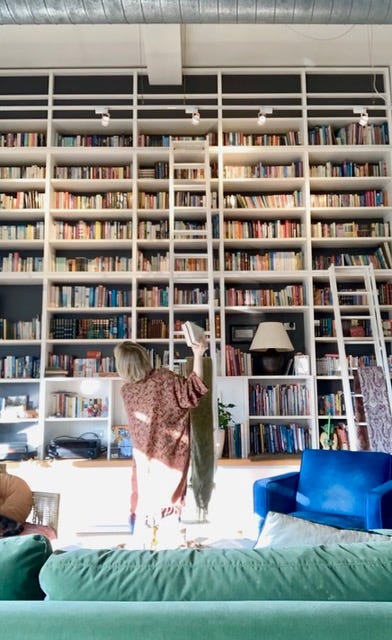
I recently took part in the Global Book Crawl, a self-guided route through independent bookshops around the world, and it struck me again how fortunate we are in Melbourne and how precious these places are, how many life-affirming or even life-changing human exchanges occur in them. I feel a special loyalty to Readings because they gave me an opportunity in 2012 when I’d never worked in a bookshop; I was the Children’s book buyer for their flagship store. That job changed everything for me. And there are so many other bookshops that I owe my career as an author to — independent booksellers hand-selling my work. I wouldn’t have a writing career without those places and those people. I also spend a lot of my writing time in libraries — the most comfortable chairs for writing are the armchairs in the Redmond Barry Reading Room of State Library Victoria.
Finally, do you have any upcoming projects or events that you would like to share and where can we find you online?
My next book is an illustrated collection of junior stories about two animal friends, which fulfils my ambition to write an homage to the Frog and Toad stories by Arnold Lobel. They are being illustrated by the brilliant Sarah Zweck, who is well-known for Here Come the Cousins with Maggie Hutchings, Wanted: the Cutest Baby in the World with Davina Bell, and her own story, Ray. The collection will be published by Walker and I can’t wait!
Fabulous interview Gemma! Emily Gale sounds so interesting and she was so open with her responses to your engaging questions. Her work sounds intriguing to me.
Oh my her library!! 😮